Growth is a double edged sword. Unchecked, growth can be cancerous and destructive. It is this type of ceaseless expansion that has put our society into the precarious environmental and financial positions in which we currently find ourselves. On the other hand, growth can be regenerative and life-giving. Following a forest fire or a bitter winter, the first green shoots to emerge from the earth bear witness to the earth's ability to restore life in the wake of disaster.

My goal for this blog is pretty simple and open-ended: I want to document and share with family and friends my efforts to incorporate an ever increasing degree of self sufficiency, voluntary simplicity, and environmentally-conscious design into my life as a would be urban homesteader.


Tuesday, November 16, 2010

My Grandma's Coffee Cake


Working in a school, there are often snacks or treats around at faculty meetings and in our small devotion groups. They are almost always either doughnuts or store bought snack cakes. The doughnuts vary in quality. I hate Krispy Kremes with a passion, but if we're lucky someone will stop by Donut Delight. They make the best doughnuts in St.Louis, especially apple fritters. I refuse to eat the Little Debbie cakes that kids insist on bringing to small group. I find a twisted sense of humor in reading the ingredient list and nutritional information to the kids while they're joyfully cramming swiss cake rolls in their mouths.

This past week I volunteered to bring food to our morning faculty meeting, and I decided to use the opportunity to introduce my coworkers to a long time tradition in my family - home made coffee cake. One of my earliest memories of my Grandma Lorenz is the baked goods that were always at her house. Cookies, rolls, bread, and especially coffee cake. I'm embarrassed to admit that this was the first time that I've ever used her recipe myself. The family cook book has a basic coffee cake dough recipe that can be topped with just about anything. One batch is enough for about 4 coffee cakes at 11x14 inches each. You can also use this dough to make her amazing pineapple cinnamon rolls (which I did). One coffee cake's worth of dough will make 8-10 rolls.
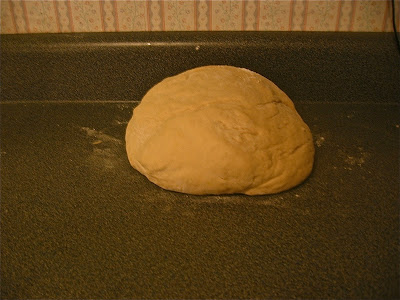
Once the dough has been kneaded, it needs to sit and rise for about an hour (or until it doubles in size). I dusted the counter with flour and covered the dough with a damp towel.

Once it has risen, you need to divide the dough and roll it out. I try to roll it to about 1/4" thickness. I placed it in greased baking pans and pressed around the edges to create a crust. You then let the dough rise again until it has doubled in thickness. This took about 45 minutes. If you are using a fruit topping, then you can put on the fruit and crumb topping after it is done with the second rise. If you are making Peanut Butter coffee cake, then you would poke a bunch of holes with a fork to prevent large air bubbles from forming.

At this point you can put the coffee cakes into the oven. The recipe is rather vague about baking time saying only, "bake until done". Mine were in there for about 30-35 minutes.

The finished product. Peach is on the left and Peanut Butter is on the right. I spread the peanut butter topping on the cake after it had cooled. Cut into 1.5" strips and demolish them with coffee or elderberry tea.

To make pineapple cinnamon rolls, roll the dough out the same way that you would for coffee cake. Brush some melted butter onto the dough and sprinkle liberally with cinnamon and sugar. Use a pizza cutter to cut the dough into 1.5" strips and roll them up. Pinch the end smooth.
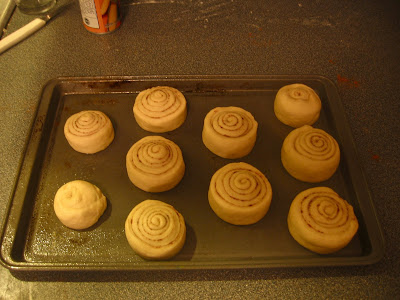
Once the rolls are rolled up, they need to sit and rise for about 45 minutes. I scooted them closer together on the pan, and spooned the pineapple topping over them. Bake them for 35-45 minutes, depending on how thick they are.

It's hard to tell in the picture, but after the rolls come out of the oven and have cooled down, I poured a simple powdered sugar glaze over them. Delicious for breakfast, lunch, supper, snack, in the car, in the shower, middle of the night...

Tuesday, November 2, 2010

Winterizing the garden


The chickens had fun rummaging around in the remains of the tomato beds.


Temps are starting to dip a bit here in St.Louis. October 30 is our average 1st frost date, and last Thursday the 28th Jack Frost showed up right on time. This past weekend was the first time in over a month that we weren't out of town or doing something at school, so I finally had time to clean up around the 'burbstead. I puled out the last of the tomato plants, put the cages and hoses away, and put up a row of hoops over the bed of winter greens. I mowed the grass, leaves and all, and filled the two semi-raised beds with the clippings so it could all compost in place over the winter. Das Cluck Haus is back in the garden where it gets moved around all winter long. It's kinda odd to look out at the space that was so packed full of vegetation just a few weeks ago and see it more or less cut back and bare now. Everything is cyclical though, and my mind has already started planning for the end of winter and the beginning of next spring. Oh the possibilities...

The last haul of tomatoes and peppers from the garden.


Wednesday, October 27, 2010

The other side of crazy...


57 days ago I noted that I was officially entering my crazy time of year. I haven't posted anything since then. To be honest, there hasn't been a whole lot going on around the 'burbstead during that time. Football season has a way of sucking up every last moment of spare time. In 2 short days, I'll be done. THANK GOD!

Fall planting wasn't quite as robust as I would have liked. I got in a bed of lettuce, chard, and spinach, but no peas, beans, or carrots. Next year I will do better. I picked up some blackberry plants for 50% off a couple of weeks ago. I got 6 of them for $15. They're going to be trellised along the fence down one side of the back yard.

I also found a food dehydrator on Craigslist for $15. I've run apples, bananas, and yellow pear tomatoes through it so far. It works like a champ, and it's so much easier than canning. I still want to build a solar dehydrator, but one thing at a time I suppose.

Tomorrow I will turn 31. Honest to god middle aged. Holy shit. Oh well. Tonight the Boy and I are going to see Hank III. It oughta be a damn good time!

Tuesday, August 31, 2010

Sunset for the Summer garden


The sun setting behind das Cluck Haus


Tomorrow is the 1st day of September. Holy hell. I have officially entered my crazy time of year, as evidenced by the lack of posting. Once the month of August rolls around, I get swept up in back to school meeting, football practice, teaching class, football practice, student council activities, football games, the boys going back to school (1st grade this year), and occasionally coaching football. All of that cuts my available free time down to about nothing. This, ironically, all happens at one of the busiest times of the gardening cycle as well. The garden is pumping out food everyday and the farmers markets are full as well. Its the time when you start to put away the excess bounty of summer for the colder times to come - canning, drying, freezing, etc. This is also the time to plant your fall garden so that you can have another harvest of peas, lettuce, spinach, and chard; as well as getting your winter crops in order so that they can sprout and grow before the days get short and the temperature dips too low.

The garden or work, kids or canning...which do you think gets left on the back burner? So rather than being an abundant source of nourishment for my family that is transitioning smoothly from one seasonal cycle to the next, my garden is a weedy-ass mess complete with over grown tomato vines, okra that's way beyond harvesting, cantaloupes that have been pillaged by squirrels and bugs, beds that should have been cleared and replanted 1 or 2 weeks ago, a mosquito swarm that puts the Congo to shame, and precious little food actually coming out of it. Yeesh!

And yet, all I can really do is keep plugging away. While I know that it's not technically the end of Summer yet, September and back to school time have always make feel like Autumn is here. I really want to get my Fall garden stuff in order this weekend so that it can at least have a chance to get started. Once (if) I get everything planted, I'll do a run down of what I'm trying out, and a recap of how different crops did this past summer.
One of my Beam's Yellow Pear Tomato plants, still going strong


Wednesday, August 4, 2010

Homesteading as art


Being an artist/art teacher by trade, I have the opportunity to create and be surrounded by beautiful drawings and paintings and sculpture all the time. But while fine art is something that I love, I think that the creative spark that resides in all people extends far beyond paintbrushes and pencils. One of my favorite quotes comes from Dada artist Marcel Duchamp, and I think it distills nicely what the creative spirit is all about:

"It's not what you see that is art, art is the gap"

Art is recognition, the ability to make connections between things and ideas, to appreciate beauty in the world around us. And when it comes to beauty, a functioning homestead (or 'burbstead) is resplendent with it. Humans have a pretty hard time holding a candle to nature's ability to create things of aesthetic value. What we do have a knack for, if only we slow down and open our senses a bit, is the ability to appreciate the beauty - to see the gap. Gardens, kitchens, farms, markets, forests, all of them contain a wealth of sights, sounds, scents, tastes, and textures. Our job is merely to care for the world that makes them all possible.

So I leave you with a picture of something that caught my eye this morning as I was waterig the garden. For my money, an okra blossom is probably the prettiest flower that will show up in a vegetable garden. Squash vines have big, showy, bright orange cones, and melons, tomatoes, and cucumbers are covered with petite yellow ones; but an okra plant puts out a real flower with petals. They are the most subtle shade of pale greenish yellow, almost white. This contrasts wonderfully with the dark, rich, blood-red center, black stamen, and intense yellow orange pollen grains. Simply beautiful, especially when situated amongst the large, sap green stalks and leaves of the plant. Enjoy!


Sunday, July 25, 2010

Book Shelf : The Big Picture


I like to read quite a bit. I don't watch TV, and I hardly listen to the radio, so I get the vast majority of my information and entertainment from magazines, newspapers, and books (and of course, the good ol' internet tubes). I regularly haunt the St.Louis County library, and I'm slowly building a personal collection of books that I find inspiring, informative, or otherwise worthwhile. This is the first in what's sure to be a sporadic and informal series of book reviews and recommendations.

For the installment, I've picked 5 books that aren't really "how-to" guides, but rather are inspirational stories about their authors' lives. Some of them are instructional in parts, but overall, they deal more with the big picture of living a more self-sufficient life.

Gene Logsdon is a farmer from Ohio who also happens to be a gifted and very prolific author. He's written over 20 books that range from novels to informational non-fiction. 'The Contrary Farmer" is about common sense, small scale farming that is rooted in a genuine love for the land that is being stewarded. Logsdon balances practical know-how with beautiful prose to create a book that informs while still being a pleasure to read.


Perry has an easy going and humorous way of relating the ups, downs, and corkscrews of rural life. While not a farmer by trade, his stories and anecdotes deal with his attempts at raising chickens and pigs, fixing up an old farm house, and the birth of a new child. He filters many of these episodes through his memories of growing up on his parents farm. It's a warm and funny read that is sure to have at least a few parts which any aspiring homesteader can relate to.


The premise of this book will be familiar to people acquainted with the local food movement. For one year, the author and her family attempt to only eat food that a) they grow themselves or b) they get from farmers and producers in their bioregion. Along the way they realize just how difficult (if not impossible) it can be to get many of the foods that we consider staples from a local source. As a result, the Kingsolvers broaden their diets, acquire new skills, and develop a deeper appreciation for many of the culinary luxuries that we take for granted. The recipes and sidebar additions from her daughter and husband make this book truly a family project, and it is a lot of fun to see them work their way through it.


In "Better Off", Eric Brende asks a very thought provoking question: How much technology is necessary in a society for its members to enjoy full and leisurely lives? He chose to address this query for his Masters thesis at MIT by moving with his new bride to an ultra conservative, Amish-style community. For the next 18 months, the Brende's lived without electricity, a car (mostly), and virtually all of the other conveniences that make up the fabric of day-to-day modern American life. In doing so, he comes to understand the multi-faceted value of doing things the "hard way". He also notes the inseparable nature of manual labor and genuine community. In the end, a surprising allergic twist seems to be the only thing that keeps the couple from joining the community for good. I picked this book up without realizing that the author lives in St.Louis, and is active at Soulard Farmers Market. I've since met his wife and would love to have the opportunity to talk to him personally. I read the book in two days (I couldn't put it down), and I would highly recommend it to anyone who is interested in self sufficiency, technology issues, or simple living.


The previous four books all deal with, or at least take place in, rural settings. "Farm City" appealed to me because it focuses on this seemingly oxymoronic concept of urban agriculture. Also, Novella Carpenter is funny as hell. She and her boyfriend move to the ghetto in Oakland, California. She proceeds to carve a farm out of an abandoned lot with bums, gangbangers, and crackheads for neighbors. While I don't exactly live in the 'hood, her exploits here really resonated with me. I saw myself in many of her triumphs and failures. She exposes the incredible amount of waste that a city generates, and puts it to good use raising animals and plants. She tackles the issue of eating sustainable and ethically produced meat by raising and butchering her own chickens, ducks, geese, rabbits, and hogs. She breaks down many of the common stereotypes about what it means to live in the city and what it means to be a farmer. It's genuine, hip, hilarious, and very inspiring. I can't recommend this book enough to anyone who aims to be an urban homesteader.


Sunday, July 11, 2010

The Tomatoes come rolling in...

My tomato plants are starting to do their thing (which is good, because everything else is taking its' sweet time). Here are a few of the ones that are ripening up so far: left to right, Silvery Fir Tree, White Currant, and Beam's Yellow Pear