Growth is a double edged sword. Unchecked, growth can be cancerous and destructive. It is this type of ceaseless expansion that has put our society into the precarious environmental and financial positions in which we currently find ourselves. On the other hand, growth can be regenerative and life-giving. Following a forest fire or a bitter winter, the first green shoots to emerge from the earth bear witness to the earth's ability to restore life in the wake of disaster.

My goal for this blog is pretty simple and open-ended: I want to document and share with family and friends my efforts to incorporate an ever increasing degree of self sufficiency, voluntary simplicity, and environmentally-conscious design into my life as a would be urban homesteader.


Sunday, February 20, 2011

Community building and the Rule of Three

No doubt, anyone who is vaguely interested in the concept of urban homesteading has already heard about the dramatics surrounding the Dervaes family of Pasadena, California and their attempt to copyright a list generic terms including: urban homestead, urban homesteading, and several more. I first heard about it on Jack Spirko’s fantastic “Survival Podcast” this past Friday, and then Autonomy Acres sent me a link to Sharon Astyk’s article. I’m really disappointed to have to write this post, but I think it’s important to stand up your principles. When I first became interested in the concept self-sufficiency within the urban context, the Dervaes family and their Path to Freedom website were huge inspirations for me (and in theory, they still are). Their level of media exposure and high degree of agricultural success of such a tiny area has in many ways made them the face of the urban homesteading movement. That has only served to make this recent turn of events all the more bizarre.

It’s been pretty awesome to see how quickly and loudly the urban homestead/self-sufficiency community has repudiated the validity of the Dervaes’ claims. This movement is all about trying to build community, both where live and virtually through the web. The whole concept of community is based on sharing, giving and receiving, and building each other up. Does that mean they don’t have the right to trademark their own work and profit from it? Of course not, but the Dervaes have gone so far beyond that as to be laughable. They are, in effect, attempting to claim ownership to the whole movement. The irony here, is that while their actions are operating in direct opposition to the idea of community building, the reaction from UH/SS bloggers has been intensely communal. People have come together to say that one person (or family) doesn’t have the right to tell everyone else what they can and can’t say about walking their own path to freedom. This movement belongs to all of us.

At this point, the Dervaes family has made some wishy-washy statements about this being a hoax and that people have misunderstood them…and yet they haven’t come out and officially, unequivocally rejected the claims that they feel are erroneous. To be honest, I think they were surprised at how quickly this came back to bite them. Also, the bottom of their blog still contain the following:

COPYRIGHT © 1998-2011 Dervaes Institute. All rights reserved. 
Photos and content cannot be reprinted or reproduced in any form without prior written consent. 
Path to Freedom, Urban Homestead, Urban Homesteading, Grow the Future, Homegrown Revolution (and trowel/fist logo) are registered ® trademarks of Dervaes Institute.

I like what this family has done in the past, but I can’t condone what appears to be nothing more than a selfish, short-sighted money grab on their part. What you put out into the world comes back to you times three. Assuming there are no dramatic turn arounds here, the Dervaes deserve everything they have coming to them. I’m joining others, and removing their link from New Growth. I’ll also continue to use many of their allegedly trademarked terms, and if Jules doesn’t like it, he can kiss my urban homesteading ass.

Wednesday, February 16, 2011

DIY Soil Block maker


Ever since I read Eliot Coleman's "New Organic Grower", I've been interested in the concept of using soil blocks to start my seeds. Soil blocks are exactly what they sound like. Instead of filling plastic seed trays with potting mix, you mix up a variety of things, and then use a glorified Play-Doh tool to make little square blocks out of the soil. These blockers will usually press a little divot in the top of the block to place your seed in. They're not terribly expensive, and you can buy them online at a few different places. One of the main advantages that they have over seed trays is that the seedlings roots will naturally prune them self at the edge of the block, rather than circling the inside of the tray and becoming potbound. This makes potting on easier and reduces root shock when you transplant to the garden. Sounds good so far. Besides, if it's good enough for Eliot Coleman and the Dervaes family, it's worth a shot...right?
The cost of a block maker that produces 2" cubes ranges from $35 to $100+. My German heritage didn't take long to kick in and say "That's highway robbery, surely you can make one yourself for next to nothing". So I cobbled together so random things that were laying around my classroom.

The lid fit snugly inside the plastic jar. I drilled a hole in the middle of both of them.


I put the bolt through the holes.


I fastened the lid to the bolt in between two nuts and a washer.

I can now pull the handle back, fill the jar with soil, and push it out. The nut on the bottom creates a divot for the seed. The commercial block makers can make 2, 4, or 6 square blocks at a time. This contraption knocks out 1 round block a shot. We'll see if they are worth the trouble.


Wednesday, February 2, 2011

They say it's your birthday...

One year (+ one day) ago, I started writing this blog. It was cold, there was snow on the ground, and I was chomping at the bit for Spring to get here. 366 days later, things are exactly the same. I'm not really sure what prompted me to start doing this. Mostly I suppose that I like being able to look back and see what I've accomplished. Conversely, I can also look back and see what I've managed to successfully put off (cough*rain water tank* cough). In any case, I'm certainly not trying to get famous considering that my "following" amounts to my brother, Autonomy Acres, and some Muslim guy who apparently subscribed to my blog by accident. Whatever.
I think the best thing that I've gotten out of doing this page is that it's given me the opportunity to check out a lot of other homesteading blogs. It's nice to see that there are other people out there who are interested in doing the same sort of things that I am. Through our collective successes and failures, we can help each other figure out how to live more self sufficiently. I need to be more intentional about helping to build that community. Along with adding a links section (something that I can't believe I've neglected to add for a whole year), I'll try to highlight a cool homesteading blog once a month or so.
The weather is frigid, and growing things seems a long way off at this point. In just a few short weeks, however, I'll be planting seeds and laying the ground work for the early spring garden. From there it's off and running for another year. Here's to 12 more months of trying to decrease my family's dependency and increase our self-reliance.

Thursday, January 20, 2011

Eating real food vs. the modern American palette

Pickles
(Click on the comic strip to see the whole thing)

This comic strip was in yesterday's St.Louis Post Dispatch. First let me say that it's a little disconcerting to find myself identifying so readily with a cartoon character who looks like Wilford Brimley. At any rate, I've had this exact same conversation with my own sons and my wife. My dad taps a bunch of maple trees down home, and for the past few years we've cooked up a bunch of real maple syrup in the spring. It's a bit thinner than fake syrup with a more complex flavor, but oh man is it good. I refuse to eat fake syrup on pancakes and such. If we're out of maple syrup, I'll use molasses or tomato preserve. My daughter always requests "Grandpa Doyle's syrup" on her pancakes. The boys and my wife, however, won't touch the stuff. Arguments about how store syrup is fake and HFCS is bad for you are of no avail. As far as they're concerned, fake syrup is the real syrup. That runny maple stuff might as well be creek water. On the one hand, it's hard to blame them for thinking that way. Until we started making maple syrup down home, I can only recall ever having the stuff once or twice when I was a little kid. We'd never buy it at the grocery store because real maple syrup is crazy expensive. So as far as most Americans' frame of reference is concerned, fake syrup actually is real syrup, becasuse it's all they know. In their brains and tastebuds, that's what syrup is supposed to taste like. It reminds me of a scene from the first Matrix movie:


The character Mouse goes on to speculate that perhaps the machines running the Matrix couldn't figure out what chicken tasted like, and so they made chicken taste like everything. One of the reasons that the Matrix is such a great movie is that it's an incredibly powerful allegory for modern industrial civilization. Most Americans now days have no idea what real food tastes like. For our entire lives, our expectations and preferences about food should look smell, feel, and taste have been shaped by corporations with little (if any) concern for our health and no understanding or interest in whether or not our food was real. In fact, food manufacturers prefer fake to real food in virtually every instance because the inputs for fake food are cheaper, and fake food has a shelf life that fits the industrial distribution model. Whole swaths of the grocery store are, as Michael Pollan puts it, little more than rearrangements of corn,soybeans, or both.

Given all of that, it's no wonder that our brains recoil a bit when we're presented with real food. "Syrup's not supposed to taste like that! These green beans are too crisp! Why are there bones in this chicken?" The irony, of course, is that we're rejecting the genuine as artifical, when it is our understanding of cullinary reality that is artificial.

What amazes me the most about this situation is that once your give up the fake food for a while, and once your body has acclimated itself to the sensations attendent to real food, the fake stuff tastes... fake. To me, HFCS based pancake syrup tastes acidic and chemically. Most canned vegetables are lacking in flavor and texture, and canned soups are overly salty. Don't get me wrong, we have all of those things in our house right now (the first as a conceit to my wife and sons, and the other two because my home canning operation is not yet as robust as I want it to be). I'm doing my best to eliminate processed foods from our diet, but it can be difficult at times given my family's corporately formulated expectations. Getting past that is largely a matter of continuing to provide them with wholesome, fresh, real food.

Yes son, maple syrup is supposed to taste like that. Our preferences and personal tastes, however, are simply all in our head.

Monday, January 10, 2011

Goals for 2011

Ok, so 2011 is a week and a half old now, and it’s time to get organized for the coming year. There are plenty of things that need to happen around the ‘Burbstead. Some of them are exciting, new projects, some of them are lingering from last year. Rather than calling these resolutions, we’ll say that they’re goals. Goals strike me as something that you can chip away at a bit at a time, rather than something that has to happen all at once. I’ll try to check back in a couple of months to see how my progress is coming.

Garden:

1. Grow an “Egg Patch” in the garden. This coming Spring, will make two years that we’ve had chickens here. We give them every opportunity to forage in the yard and are constantly feeding them kitchen and garden scraps, but the bulk of their food still comes from the feed store. While the eggs we get are of a noticeably higher quality than store eggs (a fact made obvious when I happened to use one of each in a recipe recently), we’re essentially buying our eggs from the feed store. In an effort to increase our degree of self-reliance, I’m going to dedicate a portion of the garden this year to growing food for the chickens. At this point, I plan to plant Mangel Beets, Danvers Carrots, and Turnips (for roots and greens). I also want to include cracked corn and sorghum seed from my parent’s house. The root veggies will be shredded or chopped somehow, and mixed with the other stuff.

Goal: Grow ½ or more of the feed my hens eat this coming year.

2. Get serious about season extension. I’ve dabbled with cold frames and low tunnels in the past, but it has certainly been nothing to do my collection of Eliot Coleman books proud. I currently have lettuce and spinach under cover, and it has supplied me with a couple of salads this winter. I plan to use it along with my cold frames to get an early jumpstart on the garden this Spring. The bigger plan, however, is to try to complete the larger hoop house that I’ve been planning for a year or so now. The idea is to use the frames from a couple of old trampolines to build the hoops, and use lumber (1x4’s) to connect them. The end result would be 12’ wide and about 20’ long. I have one trampoline now, and I’ll need 2 more. I’m keeping an eye on Craigslist, as people occasionally list them in the free section.

Goal: Maximize my existing season extenders, and complete work on a 12x20 hoophouse.

3. I need to grow more herbs. Thus far my herb growing hasn’t extended much past cilantro, basil, and a bit of oregano. I have seed for a variety of different things, I just haven’t made planting and using them a priority. This year I want to expand my garden beyond just vegetables, and then learn how to the things I grow.

Goal: Grow more herbs than I have before, including a traditional herb spiral somewhere in the garden.

4. Documenting my harvest. For the past couple of years I’ve kept a garden journal of sorts. I generally start off keeping pretty specific records of what varieties I’m planting, planting dates, where things are going in the garden, the progress of different plants, etc. By the time that the end of summer rolls around, my record keeping is much more sporadic, and by the end of the fall, it’s fairly non-existent. These records have been helpful from year to year, but I’d like to have a more concrete idea of how much we’re actually getting from the garden.

Goal: This year I need to keep up with my garden records better than I have in the past, specifically tracking the amount of produce that we harvest.

5. Planting in the front yard. 2011 is the year that my garden is going to break out of the back yard. The front side of our house faces west, so parts of the front yard get decent mid-day to late afternoon light. However, there is an enormous oak tree right in the middle of the yard, so a lot of space is in pretty constant shade. The challenge will be to find a mix of partial sun and shade loving plants that are edible and landscape well. Also, I’ll have to figure out how best to keep wascally wabbits out.

Goal: Plant/install edible landscaping in front of the house that is aesthetically pleasing, productive, and compatible with the front yard’s microclimate.

Projects

1. Rain catchment. It was just about a year ago that I got a 275 gallon tank from a guy off of craigslist. It was purchased with the intent of running a gutter downspout into the top, and putting a spigot for a hose in the bottom so that I could water the garden with rainwater when things got dry. Somehow, it has not managed to work its way to the top of the priority list in the past 365 days. I need to get off of my ass and make this happen this Spring.

Goal: Finish the rain catchment tank…pronto.

2. Clean out the chimney. For right now, the wood stove thing doesn’t look like it’s going to happen. We do, however, have a perfectly good fire place right here in our living room. I hadn’t had a fire in it since we moved in almost 2 years ago, and when I tried to start one in early December, it clearly wasn’t venting properly. A trip to the roof plus some climbing into the fireplace revealed that there is an undetermined amount of leaves and sticks in there. I recently borrowed my uncle Randy’s chimney sweeping tools so I can clean it out, and use the fireplace again.

Goal: Get the fireplace up and running in time for it to help heat the house this winter. Also, scrounge up enough free wood to make this worth while (no $5 bundles of gas station wood for me)

Food Storage/Prep

1. Get organized. I’ve been canning for 3 years now, a little more each year. This year I’m going to try using one of my mom’s pressure canners. Last Fall I bought a dehydrator, and I have an upright freezer in my basement. I’ve used all of these food preservation methods in varying capacity, but I haven’t really pushed myself on any of them. This year, I’d like to really work at filling my storeroom. I want to start my food preservation earlier in the summer, and put up food in quantities that are going to have an increasingly meaningful impact on our food security.

Goal: Preserve more food than I have in years past. Utilize freezing, drying, and canning to maximize my food storage; and look to farmers markets and grocery stores – as well as my own garden – to find food to preserve.

2. Solar cooking. The use of solar and haybox cookers is a practice that goes back over a hundred years. While I don’t figure they will replace our stove or oven any time soon, I think it’s a smart thing to investigate, and a useful skill to have should the need ever arise. I don’t currently own a solar cooker or a haybox, but both can be built fairly easily and inexpensively.

Goal: Build a solar cooker and haybox. Learn how to use them proficiently enough that Renee and the kids will eat meals I cook with them.

3. Meat chickens. Oooh boy. Of all these goals, this is the one that is most fraught with marital danger. I purchased our initial flock of chickens at the Baker Creek spring planting festival in 2009. I did so without consulting my wife first. To say that she was not thrilled would be a gross understatement. Over the course of the past year and a half, she has wasted no opportunity to remind me of the time I “drug home those damn chickens”. To be honest, they don’t really affect her day to day life that much. The kids and I feed them and check for eggs. Occasionally she will help me move the coop. Nevertheless, that initial shock of finding poultry in our house has put a bad taste in her mouth with regard to further chicken ownership. Still, I think anyone who has ever seen the conditions in which industrial chickens are raised and processed has to at least consider raising their own birds. Sure you can buy free range chicken from local farmers at the farmers market, but to be honest, that stuff is always way more expensive than I can afford. Will I be able to convince my wife that it is a worthwhile investment of time and money to raise our own meat chickens? I don’t know, but after the last time, I’m certainly not going to buy them without asking first.

Goal: Expand our small livestock operation to include meat chickens. If they get the ix-nay, plan B is rabbits. Wish me luck

Wednesday, December 15, 2010

Prepping and Pocketknives

Rob - who blogs at One Straw- recently posted a genius, if somewhat generalizing, thought about how to tell people who are interested in preparedness and self-sufficiency from those who are not.

"I have often thought that one could draw a loose, but fairly accurate, line through male society along the line of Those That Carry Pocket Knives and Those That Do Not. Go to any birthday party and when the stubborn ribbon hits, there is always one or two people there that quickly reach into their pocket to produce a small tool to do the job."

I grew up around men who carried pocketknives, almost to a person. It seems like a silly little thing to make note of, but it really is indicative of a broader mindset - when push comes to shove, I'll try to do things for myself. I always carry a small folding pocket knife and a leatherman-type tool. I think it's also indicative of the mindset of young people raised in a dependent, frightened, urban environment that most of my students express fear or anxiety when I get my knife out to use it for something. In most of their eyes, a knife is a dangerous thing, and the only reason that someone would have one on them is to do bad things. I hope to raise my kids to understand how to properly use and appreciate tools, and to have an "I'll do it for myself" attitude. In short, I want them to be pocketknife carriers.

Monday, December 13, 2010

132 pages of Spring

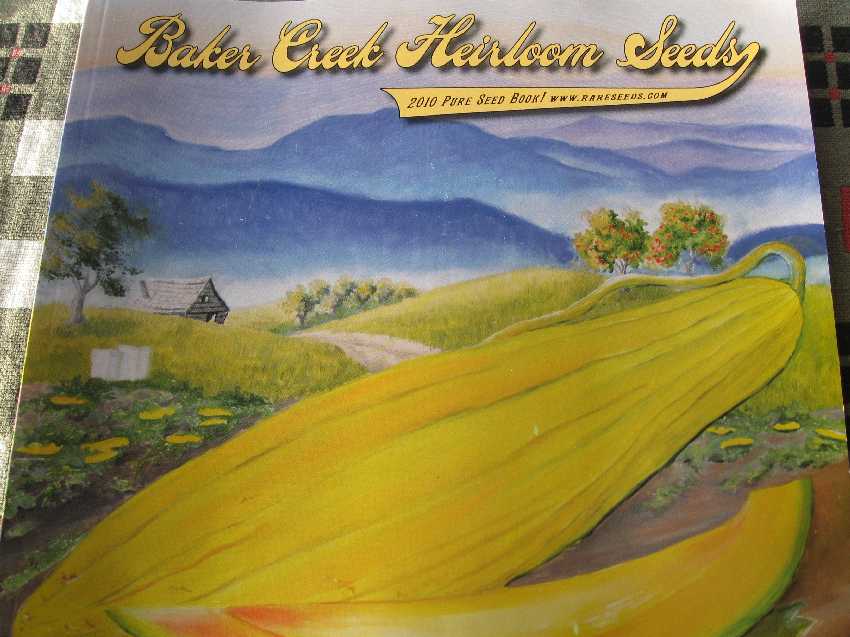
Last year' Baker Creek Seed Book


Winter kicked into high gear this past weekend here in St.Louis. On Saturday night, a cold front came through that dropped a couple inches of powdery snow and frigid temperatures on us. The high today was 19 degrees, with a low of 3 degrees! For the next 7 days, the high temperatures aren't expected to get above freezing. While this may not impress anyone from the mountain states or the great white north, it feels pretty damn cold to this Missouri native. Not unseasonably so, mind you. We seem to get a couple of these cold snaps a winter, although they usually don't show up until January or February. Never the less, everything is pretty frozen around here. The heat lamp in das Cluck Haus went on yesterday, and the girls got some extra straw to help keep them warm.

In spite of the cold, however, it feels pretty sunny in the house right now. Today I got the 2011 seed catalog from Baker Creek Heirloom Seeds. I order pretty much all of my seeds online, but there's something about holding an actual magazine in your hands that's nice. It reminds me of looking at old Burpee catalogs at my Grandma Lorenz's house as a kid. The Baker Creek seed book trumps anything Grandma ever had though. It's large formatted, square bound, and chock full of big, beautiful pictures of a bazillion different kids of fruits, vegetables, flowers, and herbs. It's like a coffee table book. And the kicker is, they send one to you for FREE. In a day when most places will charge you $5 or more for a raggedy black&white catalog on newsprint paper, Baker Creek gives away something that you might buy at a bookstore. Go to their website and look around. Then request one of their catalogs. I guarantee it'll take the edge off of winter's cold when it shows up in the mail.

Jere, Sasha, and Emilee Gettle, and the single ugliest outfit ever worn in human history